
 Following a provocative LinkedIn post and discussions with Dave McGlasson, MS, MLS, I initiated a dialogue with Pall T. Onundarson, M.D., at Landspitali/University of Iceland, Reykjavik, regarding the Factor II-X (Fiix) prothrombin time. Here is our discussion in Q & A format:
You are asking some great questions, and I fear some of my answers may be speculative to a degree:
- Does the Fiix improve on the predictive value in warfarin overdose when the INR exceeds 5?
Answer: I cannot really state that. However, during Fiix monitoring, which we have used to monitor our patients since 2016, we hardly ever observe a Fiix normalized ratio of 10. We think that a lot of those very high PT-INRs were caused by fast changes in FVII, and that many of those high PT-INRs were amplified by low FVII and were less predictive. - Does the Fiix faithfully track warfarin dose during the initial treatment period when the PT/INR is unreliable?
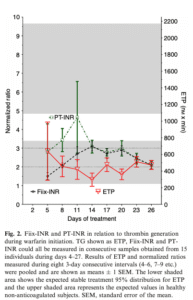
Answer: Yes. The Fiix normalized ratio predicts thrombin generation better than the PT–INR during initiation and dose changes. Indeed, we have shown that the Fiix-NR accurately “mirrors” thrombin generation, whereas the PT–INR less accurately does. Figure 2, which appears here, illustrates the difference between the PT–INR and the FiiX PT, where you can tell that the Fiix-NR better reflects the anticoagulation level as measured by endogenous thrombin potential. The figure is from Jonsson PI, Letertre L, Juliusson SJ, et al. During warfarin induction, the Fiix-prothrombin time reflects the anticoagulation level better than the standard prothrombin time. J Thromb Haemost. 2017;15:131–9. doi: 10.1111/jth.13549. PMID: 27774726, - Has the Fiix been compared to the CFX and does the Fiix have favorable predictive values?
Answer: We have not had the opportunity to do that. I am personally convinced that it does correlate much better with CFX than does the PT–INR. The main benefit of the Fiix-NR over CFX would be that it is a clotting test that can easily be measured on all coagulometers (this is a statement; we have used the Stago instruments and Karen Moffat and Mark Crowther the Werfen ACL 750). Those kinds of instruments are available all over the place. All dosing protocols except warfarin initiation remain the same as recommended for PT–INR monitoring.
- Do you advocate for the diluted Fiix for DOACs?
Answer: Not yet. We have not had the opportunity to do that. We are a “tiny operation”. Basically, it is similar to the old LA TTIT test, a dilute thromboplastin assay. We want to see if it could be developed as a “global test”. However, the study Letertre LR, Gudmundsdottir BR, Francis CW, et al. A single test to assay warfarin, dabigatran, rivaroxaban, apixaban, unfractionated heparin, and enoxaparin in plasma. J Thromb Haemost. 2016;14:1043–53. doi: 10.1111/jth.13300. PMID: 26924677 suggests it can be done, but much further work needs to be done. Also, we need an interested commercial manufacturer to be able to take that further.
In the figure, ETP = endogenous thrombin potential.
Thanks to Dr. Onundarson for his discussion.
Click here for a second bibliography provided by Dr. Onundarson with additional references.
Here is a comment from Dr. Ali Sadeghi-Khomami, Precision BioLogic Inc. research director, comparing the chromogenic Factor X assay with the Fiix PT assay: “Reference labs in the US use the CFX for VKA monitoring. The main beauty of this assay is that it is not affected by LA. Unfortunately, there is no value in the PT–INR for warfarin monitoring of LA patients. What I am not entirely sure of is the missing element, factor-II, in the CFX. As you know, FII feedback is very critical (FV, FVIII, platelet activation), and anticoagulants like UFH, dabigatran, or VKA have broader actions and intended use than FX inhibitors (Rivaroxaban) because of that. I cannot imagine FiiX PT would be more expensive than FX-chromogenic.

Thank you for posting that, George. If your readers are interested in easy introductions to what the “Fiix” (pronounced fix) is about, see my LinkedIn posts. In addition to the clinical benefit, the Fiix test we believe can be measured on any available coagulometer; using the same equipment and pretty much same dosing instructions/guidelines as for PT–INR based warfarin dosing. The only exception is that we recommend a slight modification of the warfarin initiation protocol, see Onundarson PT, Gudmundsdottir BR. The need for an adapted initiation nomogram during Fiix prothrombin time monitoring of warfarin. J Thromb Thrombolysis. 2019 Nov;48:685-689. doi:10.1007/s11239-019-01928-4.t. In our 3 published studies, all conducted in Iceland, Fiix monitoring stabilized warfarin management with consequent 50% reduction in TE without loss of safety compared to PT–INR monitored warfarin and possibly DOACs as well. In my mind for those patients remaining on warfarin, the Fiix normalized ratio (Fiix-NR) should replace conventional old PT–INR monitoring – but some would say that Icelanders differ from the rest of human kind (being stubborn and crazy) and that larger studies are needed in a different publication. Of course we would be glad if our findings would be independently reproduced.