
Nov 28 2026
Our November 2026 QQ asked, “Which is an antifibrinolytic used to control bleeding?” There were 37 responses:
- Tranexamic acid (TXA): 29 (77%)
- Alpha-2-antiplasmin (α-2 antiplasmin, α-2 plasmin inhibitor, α-2 PI): 2 (6%)
- Tissue plasminogen activator (TPA): 4 (11%)
- Plasminogen activator inhibitor (PAI-1): 2 (6%)
Thanks to our participants for their good work! Surgeons routinely employ TXA to reduce hemorrhage risk during potentially bloody procedures. TXA is a lysine derivative that binds plasminogen and interferes with TPA‘s ability to activate it, as illustrated here. α-2 antiplasmin, labeled α-2 pla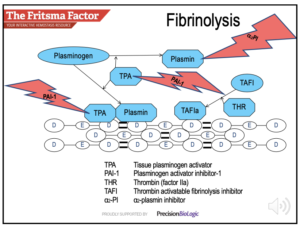 smin inhibitor (α-2 PI) in the figure, is a plasma component that binds free plasmin, a promiscuous protease. Plasminogen activator inhibitor-1 (PAI-1) controls the function of free and bound TPA. Fibrinolysis, nearly as complex as coagulation itself, is described in depth in our educational module Coagulation Overview.
Comments (0)
Quick Question Archive

No comments here.